«سیاست بایدن این بود که پیچ فروش نفت را شل کند.» این جمله را ظریف در خرداد ۱۴۰۳ گفت. آمارها هم تایید میکنند صادرات نفت که در دوره ترامپ به زیر ۲۰۰ هزار بشکه رسیده بود، در دوره بایدن ۱۰ برابر افزایش یافت اما هزینه این افزایش، سوخت شدن بیش از نصف قیمت هر بشکه نفت بود.
جواد اوجی، وزیر سابق نفت، در اظهاراتی مبهم قسم میخورد که تخفیفهای نفتی ایران، کمتر از انگشتان یک دست او، یعنی کمتر از پنج دلار در بشکه است اما نامههای افشا شده یک شرکت وابسته به وزارت دفاع نشان میدهند این شرکت، نفت ایران را تا ۲۵ دلار در هر بشکه، ارزانتر فروخته است. این پایان ماجرا نیست. حدود ۳۰ دلار دیگر در هر بشکه نصیب دلالان و عوامل پولشویی جمهوری اسلامی میشود و در پایان چیزی که باقی میماند، کمتر از نصف قیمت هر بشکه است.
منابع مرتبط با صنعت نفت جمهوری اسلامی در گفتوگو با ایراناینترنشنال این فرایند پنج مرحلهای را توضیح دادند: این هزینه ماجراجوییهای جمهوری اسلامی با استفاده از منابع ایران است.
روی تصویر کلیک کنید
چه اتفاقی افتاد؟
تا بهار ۱۳۹۰، صادرات روزانه نفت جمهوری اسلامی به نزدیک سه میلیون بشکه در روز میرسید اما در اردیبهشت ۱۳۹۰، دولت باراک اوباما، رییسجمهوری اسبق آمریکا، تحریمهای سختگیرانهای بر صادرات نفت ایران وضع کرد، به طوری که صادرات نفت ایران در بهمن ۱۳۹۱ به زیر یک میلیون بشکه در روز سقوط کرد.
با آغاز اجرای توافق هستهای موسوم به برجام در زمستان سال ۱۳۹۴، اوضاع دوباره برای جمهوری اسلامی مساعد شد، به طوری که در پاییز ۱۳۹۵ فروش نفت از سوی جمهوری اسلامی به رکورد تاریخی روزانه سه میلیون و ۲۰۰ هزار بشکه نیز رسید.
این ماه عسل زیاد طول نکشید و با خروج دونالد ترامپ، رییسجمهوری سابق آمریکا از برجام در بهار ۱۳۹۷، روند کاهش صادرات آغاز شد. کار به جایی رسید که در زمستان ۱۳۹۸، جمهوری اسلامی به زحمت روزانه ۱۹۰ هزار بشکه نفت ایران را صادر میکرد.
شل کردن پیچ تحریمها
با آغاز دولت جو بایدن در زمستان ۱۳۹۹ ورق برگشت. محمدجواد ظریف، وزیر امور خارجه دولت حسن روحانی، ۲۹ خرداد ۱۴۰۳ در برنامه انتخاباتی «میزگرد سیاسی» در توضیح دلیل افزایش صادرات نفتی جمهوری اسلامی گفت: «سیاست بایدن این بود که پیج فروش نفت ایران را شل کند.»
مهدی حسینی، معاون سابق وزارت نفت هم در گفتوگویی اظهارات ظریف را تایید کرد که بایدن عملا با سهلگیری تحریمها اجازه داد جمهوری اسلامی نفت بفروشد.
آمارها هم همین را نشان میدهد: از زمستان سال ۱۳۹۹ که بایدن آغاز به کار کرد، صادرات روزانه نفت جمهوری اسلامی که از بیش از سه میلیون بشکه پس از برجام به زیر ۲۰۰ هزار بشکه در دوره ترامپ رسیده بود، شروع به رشد کرد تا این که در تابستان ۱۴۰۲ از دو میلیون بشکه هم عبور کرد.
روی تصویر کلیک کنید
انبارهای شناور
بعد از آغاز دولت ابراهیم رئیسی که همزمان با سهل گرفتن تحریمها از سوی دولت بایدن بود، صادرات جمهوری اسلامی افزایش داشت اما این بار مثل گذشته معامله نمیکردند.
مساله این بود که جمهوری اسلامی در مخمصهای دو بعدی گرفتار شد: چاههای نفت ایران فرسوده شدهاند و به دلیل نبود سرمایهگذاری مناسب و تکنولوژی روز، همیشه باید استخراج نفت ادامه داشته باشد؛ حتی وقتی مشتری برای آن نباشد. رقبای ایران مثل عربستان سعودی، به راحتی میتوانند استخراج از یک چاه نفت را متوقف کنند اما جمهوری اسلامی این تکنولوژی را ندارد و استخراج نفت را باید به شکل مداوم ادامه دهد.
نتیجه این که برای مدتها با وجود کاهش صادرات، تولید ادامه داشت. نفت تولید شده بدون خریدار باید جایی ذخیره میشد. جمهوری اسلامی از نفتکشها به عنوان انبار نفت استفاده کرد. هزینه این انبارهای شناور روزانه به حدود ۱۵ تا ۲۰ هزار دلار میرسد.
به عبارتی جمهوری اسلامی زیر یک منگنه گیر افتاد: از طرفی بستن چاه نفت به دلیل هزینه سنگین آن ممکن نبود و از طرف دیگر ادامه تولید بدون خریدار، هزینه سنگین اجاره و نگهداری نفتکشها را تحمیل میکرد.
آغاز مفت فروشی
در دوره رئیسی در ایران و بایدن در آمریکا، اگرچه حجم صادرات نفت افزایش یافت اما این افزایش حجم بیدلیل نبود. مجید انصاری، عضو مجمع تشخیص مصلحت نظام، ۱۲ تیر ۱۴۰۳ در ویدیویی که وبسایت اصلاحطلب جماران، نزدیک به خانواده روحالله خمینی آن را منتشر کرد، گفت در فروش نفت ایران ۱۵ تا ۳۰ دلار در هر بشکه تخفیف داده میشود؛ یعنی به صورت میانگین ۲۲ دلار در هر بشکه.
این موضوع را منابع ایراناینترنشنال نیز تایید میکنند اما این تخفیف ۲۰ دلاری پایان مفتفروشی نفت در جمهوری اسلامی نیست: حکومت ایران در چند سال اخیر شبکهای را برای دور زدن تحریم و فروش نفت ایجاد کرده است. شبکهای که در سایه چشمپوشی بایدن توانسته نفت ایران را برای جمهوری اسلامی به فروش برساند.
پلهپله تا فروش
گام اول، تخفیف ۲۰-۳۰ دلاری: در گام اول، شرکتهای مورد اعتماد جمهوری اسلامی، موسوم به شرکتهای «تراستی» به صورت واسطه برای نفت ایران خریدارانی عمدتا در چین پیدا میکنند.
بهای معامله با جمهوری اسلامی در این مرحله تخفیف ۲۰-۳۰ دلاری است. موضوعی که در نامههای افشا شده هم به چشم میخورد.
گام دوم، تخلیه و بارگیری غیرقانونی روی آب و سندسازی: نفت ایران در دریا حمل میشود و در بین راه، جایی خارج از حوزه لنگرگاه کشورها، از نفتکشی به نفتکش دیگر انتقال داده میشود. شبکه نفتکشهای همکار فروش نفت ایران، برای گم کردن رد نفت، از تکنیکهای نرمافزاری هم استفاده میکنند.
این جابهجایی نفت، هزینه کارگر و حمل و نقل هم دارد و علاوه بر این برای این نفت باید سندسازی هم انجام شود و اسناد رسمی آن به نام عمان، عراق یا مالزی ثبت شود.
به گفته یکی از منابع ایراناینترنشنال، برای هر بشکه نفت در این مرحله حداقل چیزی حدود پنج تا هفت دلار هزینه میشود.
گام سوم، حمل تا بنادر شرق آسیا و کانال سوئز: خریداران عمدتا چینی نفت ایران، حاضر نیستند نفت را از بنادر و آبهای ایران تحویل بگیرند و در نتیجه، شبکه فروش جمهوری اسلامی باید نفت را تا بنادری در شرق آسیا، مثل بنادر مالزی یا کانال سوئز حمل کند تا خریدار، نفت را از آن بندر تحویل بگیرد.
در اینجا هم برای هر بشکه حدود ۱۰ دلار هزینه میشود.
گام چهارم، پولشویی و تبدیل ارز: تا همین جای کار از قیمت یک بشکه نفت -برای مثال ۸۰ دلاری- چیزی حدود ۳۵ تا ۴۵ دلار کسر شده است. جمهوری اسلامی برای استفاده از این پول، ناچار است برای آن سندسازی کند و در فرایند پولشویی، دلار را به ارزهای دیگر تبدیل کند.
برای تامین این هدف، تهران دست به دامن شبکهای از صرافیها میشود. این صرافیها با شبکه گستردهای از ایرانیان دوتابعیتی مرتبط هستند که در سراسر جهان پخش شدهاند.
اکونومیست در گزارشی نوشته است حداقل ۲۰۰ ایرانی دوتابعیتی در اروپا برای این شبکه کار میکنند.
نرخ تبدیل این صرافیهابالاست. به گفته منابع ایراناینترنشنال از آن ۳۰-۴۰ دلار باقی مانده، چیزی حدود۱۰-۱۵ دلار هم به وسیله صرافان و شبکه پولشویی کسر میشود.
چیزی که به دست جمهوری اسلامی میرسد، در واقع کمتر از نصف ارزش واقعی نفت است و بیش از نیمی دیگر، بین خریدار به عنوان تخفیف و واسطهها به عنوان کارمزد حمل و نقل و جابهجایی و نرخ تبدیل ارز، تقسیم میشود.
سفره تهاتر: روندی که گفته شد، بهترین راه برای جمهوری اسلامی است اما در بسیاری از مواقع فروش نفت به دلار ختم نمیشود. علاوه بر شرکتهای معتمد و صرافان که برای دور زدن تحریمها به وجود آمدند، طیف گستردهای از شرکتها هم وجود دارند که برای تهاتر دلالی میکنند. آنها در مقابل ارزش نفت صادراتی از چین، کالا وارد میکنند و در واقع نوعی تهاتر انجام میدهند.
به گفته یک دست اندرکار صنعت نفت ایران، این شرکتها هم به نوبه خود با فاکتورسازی، کالایی را که در مقابل نفت به ایران وارد میکنند، بالاتر از قیمت واقعی نشان میدهند. جمهوری اسلامی هم برای رسیدن به پول نفت فروخته شده، ناچار این معاملات را میپذیرد.
روی تصویر کلیک کنید
نیروهای مسلح: یک بشکه از هر سه بشکه
نیروهای مسلح جمهوری اسلامی طبق قانون بودجه سال ۱۴۰۳، مالک یک بشکه از هر سه بشکه نفت و فرآوردههای نفتی در ایران هستند. سهم نفت نیروهای مسلح در بودجه ۱۴۰۲ به مبلغ سه میلیارد یورو داده شده بود. این رقم در بودجه امسال به شش میلیارد و ۲۱۵ میلیون یورو افزایش یافته است. یعنی بیش از دو برابر سال گذشته.
قانون بودجه سال ۱۴۰۳ دولت را مکلف کرده است از طریق شرکت ملی نفت ایران، معادل ۱۳۶ هزار و ۸۵۷ میلیارد تومان، نفت خام و میعانات گازی را به صورت ماهانه بر اساس قیمت روز به نیروهای مسلح اختصاص دهد.
در همین بند اضافه شده است علاوه بر مبلغ ریالی قبلی، معادل یک میلیارد و ۸۰۰ میلیون یورو نفت خام و میعانات، برای «طرحهای ویژه» به نیروهای مسلح داده شود. نرخ تسعیر یورو در این بودجه ۳۱ هزار تومان تعیین شده است. بر این اساس ارزش ریالی این بخش هم ۵۵ هزار و ۸۰۰ میلیارد تومان است.
جمع اعتبارات این بخش برابر ۱۹۲ هزار و ۶۵۷ میلیارد تومان و به یورو برابر شش میلیارد و ۲۱۵ میلیون یورو است.
در جدول «۲۲-۴» قیمت هر بشکه نفت و میعانات گازی موضوع بند «ب»، ۶۵ یورو تعیین شده است. این یعنی قانونگذار در بودجه سال ۱۴۰۳ چیزی حدود ۹۶ میلیون بشکه نفت خام و میعانات را در سال به نیروهای مسلح داده است.
کل درآمد نفتی جمهوری اسلامی، طبق قانون بودجه، ۵۸۲ هزار و ۷۴۳ میلیارد تومان برای سال ۱۴۰۳ پیشبینی شده است. این یعنی ۳۳ درصد مجموع درآمد نفتی کشور در سال ۱۴۰۳ در اختیار نیروهای مسلح قرار میگیرد.
به بیان دیگر، یک بشکه از هر سه بشکه نفت ایران به نیروهای مسلح داده میشود.
در قانون بودجه ۱۴۰۳، شیوه توزیع ۱۹۲ هزار و ۶۵۷ میلیارد تومان توضیح داده شده است؛ بیشترین سهم از این نفت را به ترتیب سپاه پاسداران، ستاد کل نیروهای مسلح، ارتش جمهوری اسلامی، فرماندهی انتظامی جمهوری اسلامی، وزارت دفاع و قرارگاه مرکزی خاتمالانبیا دریافت میکنند.
اسناد افشا شده در جریان هک وبسایت یک شرکت ظاهرا خصوصی، اطلاعاتی درباره نحوه فروش نفت را به وسیله شرکتهای وابسته به نیروهای مسلح به دست داده است.
شرکت «تندر صحرا» وابسته به وزارت دفاع جمهوری اسلامی است که ایراناینترنشنال پیشتر به نقش این شرکت در تجارت پهپاد و معاملات آن با روسیه از طریق طلا پرداخته بود.
علاوه بر این که مدیران این شرکت به ظاهر خصوصی، از فرماندهان بلندپایه ارتش جمهوری اسلامی هستند، در یک پیشنویس از صورتهای مالی آن که در جریان هک ایمیلها افشا شد، دقیقا اشاره شده است که شرکت از جمله شرکتهای وابسته به «ودجا» است.
ودجا مخفف نام وزارت دفاع و پشتیبانی نیروهای مسلح جمهوری اسلامی است.
نیروهای مسلح چقدر تخفیف میدهند؟
سه سند از ایمیلهای هک شده «تندر صحرا» مربوط به معاملات نفتی در وبسایت ایران لیک قابل دسترسی است.
در سندی به تاریخ چهارم اسفند ۱۴۰۱، شرکتی به نام «پتروماس گروپ» برای برداشت و صادرات نفت و میعانات گازی به تندر صحرا اعلام آمادگی کرده است. نامه بدون نام امضا شده و به نظر میرسد شرکت از جمله شرکتهای صوری ثبت شده در امارات متحده عربی باشد.
در نامهای که پتروماس به تندر صحرا ارسال کرده است، جزییات یک خرید یک میلیون و ۵۰۰ هزار بشکهای ذکر شده است. در این نامه به تاریخ ۱۴ اسفند ۱۴۰۱، آمده که این یکونیم میلیون بشکه نفت در پنج مرحله ۳۰۰ هزار بشکهای از تندر صحرا تحویل گرفته میشود. به ترتیب در مراحل اول تا پنجم، قیمت هر بشکه نفت ۱۹، ۲۱، ۲۳، ۲۵ و ۲۵ دلار کمتر از قیمت نفت برنت ذکر شده است.
قیمت نفت برنت و نفت ایران اختلاف چندانی با هم ندارند. در تاریخ ۲۰ مهر ۱۴۰۳، میانگین متحرک ۲۰ روزه نفت برنت بشکهای ۷۶/۵۲ و همین عدد برای نفت سنگین ایران بشکهای ۷۲/۴۶ دلار بوده است. یعنی اختلاف آنها در هر بشکه حدود چهار دلار بوده است.
اسفند سال ۱۴۰۱ و در زمان این نامهنگاریها، میانگین متحرک ۲۰ روزه منتهی به ۲۹ اسفند ۱۴۰۱ نفت برنت ۸۰/۰۶ و نفت سنگین ایران هم ۷۶/۱۴ بوده است که اختلاف کمتر از چهار دلار را نشان میدهد.
در واقع قیمت یک میلیون و ۵۰۰ هزار بشکه نفت ایران که در این تاریخ معامله شده در حالت عادی و بدون تخفیف ۱۱۴ میلیون و ۲۱۰ هزار دلار بوده است که آن را به قیمت ۱۱۱ میلیون و ۴۲۰ هزار دلار فروختهاند؛ یعنی دو میلیون و ۷۹۰ هزار دلار در یک معامله یک میلیون و ۵۰۰ هزار بشکهای به شرکتی که نامهنگاریهای خود را با نام امضا نکرده، تخفیف داده شده است.
شرکت تندر صحرا در نامهای به تاریخ ۱۶ اسفند ۱۴۰۱ به پتروماس به شماره ۱۴۰۱/۵۱۰/اس (“S/1401/510”) نحوه محاسبه قیمت محمولههای نفتی بالاتر را به پتروماس اعلام کرده است.
طبق جدول بند یک این نامه، محمولههای نفتی در پنج مرحله تحویل و قیمتگذاری شدند.
در مرحله اول تا دو میلیون بشکه به قیمت ۱۹ دلار زیر قیمت نفت برنت، در مرحله دوم از دو تا چهار میلیون بشکه به قیمت ۱۹/۵ دلار کمتر از نفت برنت، در مرحله سوم از چهار تا شش میلیون بشکه به قیمت ۲۰ دلار زیر قیمت نفت برنت، در مرحله چهارم شش تا هشت میلیون بشکه به ۲۰/۵ دلار زیر قیمت برنت و نهایتا در مرحله پنجم هشت تا ۱۰ میلیون بشکه، به قیمت ۲۱ دلار زیر قیمت نفت برنت.
در پایان نامه هم توضیح داده شده در حالی که خریدار کل نفت را تحویل بگیرد، تخفیف ۲۱ دلاری برای آن اعمال میشود.
در واقع در اینجا پتروماس گروپ، نفت ایران را از شرکت تندر صحرا وابسته به وزارت دفاع، به طور میانگین ۱۶ دلار در هر بشکه ارزانتر خریداری کرده است.
سهم کاسبان تحریم: ۹ میلیون به ازای هر ایرانی
جواد اوجی، وزیر نفت دولت ابراهیم رئیسی در همایشی که ۱۲ تیر ۱۴۰۳ برگزار شد، با اشاره به این که برای فروش نفت کارگروهی هفت نفره با حضور نمایندگان مجلس شورای اسلامی، قوه قضاییه، سازمان اطلاعات سپاه پاسداران و وزارت اطلاعات تصمیمگیری میکند، با نمایش یک دست خود تاکید کرد: «والله و بالله، تخفیفها از عدد دست من کمتر است.»
با این که او اشاره نکرد منظورش از واحد این عدد، درصد است یا دلار اما به نظر میرسد او قصد داشته بگوید تخفیفها کمتر از پنج دلار است.
با وجود این، نامهنگاریهای هک شده شرکت تندر صحرا به عنوان یکی از شرکتهای وابسته به وزارت دفاع، نشان میدهد تخفیفهای این شرکت، لااقل در بخشی که نفت در اختیار مجموعههای نیروهای مسلح قرار گرفته است، به طور میانگین در هر بشکه ۲۰ دلار بوده است.
از طرفی طبق گفتههای انصاری، عضو مجمع تشخیص مصلحت نظام هم جمهوری اسلامی به خریداران نفت، بین ۱۵ تا ۳۰ دلار تخفیف میدهد.
منابعی هم که با ایراناینترنشنال گفتگو کردند، تخفیف ۲۰ دلاری را تایید کردند.
حدودا ۲۰ دلار هم هزینه دور زدن تحریمهاست که این یعنی روی هم هر بشکه نفت حدود ۴۰ دلار کمتر از قیمت واقعی فروخته میشود.
مرکز پژوهشهای مجلس شورای اسلامی برآورد کرده در سال ۱۴۰۳، جمهوری اسلامی روزانه یک میلیون و ۵۵ هزار بشکه نفت خواهد فروخت. قیمت پیشبینی شده هم چیزی حدود ۷۰ دلار در هر بشکه است که نیمی از این مقدار به دلالان و شرکتهای وابسته به جمهوری اسلامی برای دور زدن تحریم میرسد. یعنی روزی حدود ۳۷ میلیون دلار و در سال ۱۴۰۳، چیزی حدود ۱۳/۵ میلیارد دلار سهم دلالان نفت جمهوری اسلامی است.
این عدد به دلار آزاد، چیزی حدود ۸۱۰ هزار میلیارد تومان میشود.
نفت در ایران ملی است و در واقع دلالان نفتی در شرایط تحریم، هر روز ۲۶ هزار تومان و سالی حدود ۹ میلیون تومان از سهم هر شهروند ایرانی به جیب میزنند.
عملیات «وعده صادق-۲» تمام شد. ارزش موشکهایی که تا ۹۰ درصد به هدف اصابت نکردند ۷۹ هزار میلیارد تومان برآورد میشود. این رقم بهعلاوه قیمت موشکهای «وعده صادق-۱» به حدود ۱۳۸ هزار میلیارد تومان میرسد. یعنی به ازای هر ایرانی، حدود یک میلیون و ۶۰۰ هزار تومان خرج این موشکها شده است.
شامگاه سهشنبه ۱۰ شهریور ۱۴۰۳، جمهوری اسلامی در عملیاتی که آن را «وعده صادق-۲» نامید، حدود ۲۰۰ موشک میانبرد را به سوی اسرائیل شلیک کرد.
در میان بیانیهها و اظهار نظرها پس از این حمله، اطلاعات متفاوت و بعضا متناقضی درباره نوع موشکهای به کار گرفته شده در این عملیات، ارائه شده است.
مقامهای جمهوری اسلامی تاکید دارند موشکهای به کار رفته، هایپرسونیک بودند.
با وجود این درباره واقعیت تسلیحات استفاده شده، ابهامات زیادی وجود دارد.
موشک هایپرسونیک باید سرعتی برابر پنج ماخ (پنج برابر سرعت صوت) داشته باشد.
برخی رسانهها موشکهای جمهوری اسلامی را با موشک «کینژال» روسی مقایسه کردند.
کینژال روسی هواپرتاب است و از روی جنگنده پرتاب میشود اما موشکهای جمهوری اسلامی از روی زمین پرتاب میشوند.
صرفنظر از سرعت و نوع موشکها، آنها قطعا موشکهای میانبردی بودند که توانستند به اسرائیل برسند. موشکهایی که در ادبیات مقامات و رسانههای جمهوری اسلامی -بهخصوص در یک سال اخیر- موشک «اسرائیلزن» نامیده میشوند.
به دلیل محرمانه بودن اطلاعات نظامی، هرگز رقم دقیق و مشخصی از قیمت و هزینه ساخت موشکهای جمهوری اسلامی منتشر نشده است و حتی برآورد مشخصی نیز درباره آن وجود ندارد؛ هر چند میدانیم برای برنامه موشکی جمهوری اسلامی از زمان جنگ ایران و عراق تاکنون، با توجه به ارقام بودجه نظامی، میلیاردها دلار هزینه داشته است.
ادعای جمهوری اسلامی
آذر ماه ۱۴۰۲، در جریان بازدید غلامحسین محسنی اژهای، رییس قوه قضاییه از نمایشگاه «دستاوردهای موشکی، پدافندی و فضایی سپاه پاسداران انقلاب اسلامی»، امیرعلی حاجیزاده، فرمانده هوافضای سپاه پاسداران گفت: «هر تیر موشک فتاح ۲۰۰ هزار دلار قیمت دارد.»
جمهوری اسلامی برای ساخت موشک، با تحریمهای شدید بینالمللی روبهرو است.
این رژیم برای تامین فنآوریهای به کار رفته در موشکهایش باید تحریمها را دور بزند و حتی برای خرید آلیاژهای مورد نیاز در این موشکها، نمیتواند مستقیم خریدی انجام دهد.
سال ۲۰۱۹، نیویورکتایمز فاش کرد از زمان ریاستجمهوری جورج بوش، آمریکا در یک برنامه سری، در عملکرد برنامه موشکی جمهوری اسلامی اختلال ایجاد کرده است.
این روزنامه نوشت مقامهای آمریکایی میدانند جمهوری اسلامی برای تامین اقلام مورد نیاز برنامه موشکی خود به بازار سیاه رو آورده و از همین طریق، در برنامه موشکی آنها اختلال ایجاد میکند.
آنها با دستکاریهای کوچک در طراحی سیستمهای خریداری شده از سوی جمهوری اسلامی در بازار سیاه و حتی آلیاژهای مورد استفاده در بدنه موشکها، باعث ایجاد اختلال در عملکردشان میشوند.
از آنجا که صنعت موشکی جمهوری اسلامی اصولا بر پایه مونتاژ بنا شده است و مواد اولیه آن باید از خارج کشور تهیه شود، گفتههای حاجیزاده به نظر بیشتر تبلیغاتی و غیر واقعی است چرا که ۲۰۰ هزار دلار، حتی یک پنجاهم موشکهای مشابه خارجی هم نیست؛ حال آن که در موارد مشابه، کشورهای سازنده مثل چین و روسیه، اقلام مصرفی را از بازار سیاه تهیه نمیکنند.
برآورد بر اساس قیمت موشکهای کره شمالی
سال ۲۰۲۲، وبسایت انگلیسی صدای آمریکا در گزارشی به موضوع برنامه موشکی کره شمالی پرداخت. در آن مطلب قیمت تمام شده موشکهای این کشور از کوتاهبرد تا دوربرد، بین سه تا ۱۰ میلیون دلار به ازای هر فروند برآورد شده است.
جمهوری اسلامی و «جمهوری دموکراتیک خلق کره»، به لحاظ منزوی بودن و برنامههای تسلیحاتی شباهتهای زیادی دارند.
از زمان روی کار آمدن جمهوری اسلامی اخبار و گزارشهای زیادی از همکاریهای تسلیحاتی این دو رژیم منتشر شده است.
۱۳۸ هزار میلیارد تومان، هزینه موشکهایی که به هدف نمیخورند
بر اساس اطلاعات موجود، میتوان به تخمین گفت هر فروند از موشکهای میانبرد مورد استفاده جمهوری اسلامی در حمله به اسرائیل حدودا شش تا هفت میلیون دلار قیمت داشتهاند.
با توجه به ۲۰۰ فروند موشک شلیک شده، یعنی برای عملیات «وعده صادق-۲»، جمهوری اسلامی بین یک میلیارد و ۲۰۰ میلیون دلار تا یک میلیارد و ۴۰۰ میلیون دلار هزینه کرده است.
این رقم با قیمت دلار آزاد، تقریبا برابر ۷۹ هزار میلیارد تومان است اما همه هزینهها نیست.
هزینههای جانبی مثل فراهم کردن زیرساخت، لانچرها، هماهنگی، تبلیغات، حمل و نقل و موارد دیگر، همچنین هزینههای اقتصادی و تبعات اقتصادی مثل ریزش بورس و افزایش قیمت دلار هم وجود دارد.
این فقط ارزش موشکهای شلیک شده است؛ موشکهایی که تا ۹۰ درصد -احتمالا به دلیل همان طرح سری ایالات متحده برای دستکاری در اقلام خریداری شده از بازار سیاه و پدافند اسرائیل و متحدانش- خنثی شدهاند و تنها یک فلسطینی بر اثر اصابت بدنه آن کشته شده است.
در عملیات «وعده صادق-۱» هم که فروردین ۱۴۰۳ انجام شد، ۱۵۰ موشک به سوی اسرائیل شلیک شد. این یعنی حدود ۹۷۵ میلیون دلار، تقریبا برابر ۵۹ هزار میلیارد تومان نیز در فروردین، فقط صرف موشکهای مورد استفاده در عملیات «وعده صادق-۱» شد.
موشکهای مصرف شده در این دو عملیات تاکنون حدود ۱۳۸ هزار میلیارد تومان خرج روی دست جمهوری اسلامی گذاشتهاند که البته این هزینه از جیب شهروندان در ایران تامین میشود.
جمهوری اسلامی که به دلیل تحریمها همین حالا هم با مشکلات مالی روبهروست، اعتبارات بودجه خود را از جمله از محل افزایش مالیاتها تامین میکند.
At the height of the 2022 nationwide protests, Mashhad’s state-controlled traffic cameras suddenly went dark. This wasn’t due to a glitch or accident but was a deliberate act by Majid Khoshmanzar, an employee of the city’s traffic control company. His actions made it impossible for authorities to identify and suppress protesters at a critical time when the regime was desperately relying on its surveillance system to maintain control.
Khoshmanzar was just one of an estimated 8 million Iranians employed by and connected to the Islamic Republic’s vast state apparatus. Yet his defiance highlighted a growing truth: loyalty to the regime in Tehran is not guaranteed, even among those embedded within its system.
The Iranian state’s sprawling military, state-owned banks, and companies dominate about 80% of the economy, creating a system where many citizens depend on public sector jobs. Despite this, many state employees reportedly earn as little as $200 a month, while inflation and rising living costs push them closer to poverty.
Although these employees are rigorously vetted and constantly monitored by Ministry of Intelligence personnel, known as “Herasat” (security), economic hardship has led many to quietly sympathize with the broader population during times of unrest.
This simmering discontent has often exposed cracks within the regime’s workforce—an erosion of loyalty that could prove pivotal in any future revolution. However, for these disillusioned employees to fully turn against the regime, they need more than frustration; they need a clear and compelling vision from Tehran’s opposition, one that assures them of their place in a post-Islamic Republic era.
The presence or absence of this formidable workforce of 8 million has become particularly crucial during key moments such as elections and protests.
So, who exactly comprises this immense group that, directly and indirectly, props up the regime—and how steadfast is their loyalty in the face of growing unrest?
Mapping the Iranian state’s 8 million employees
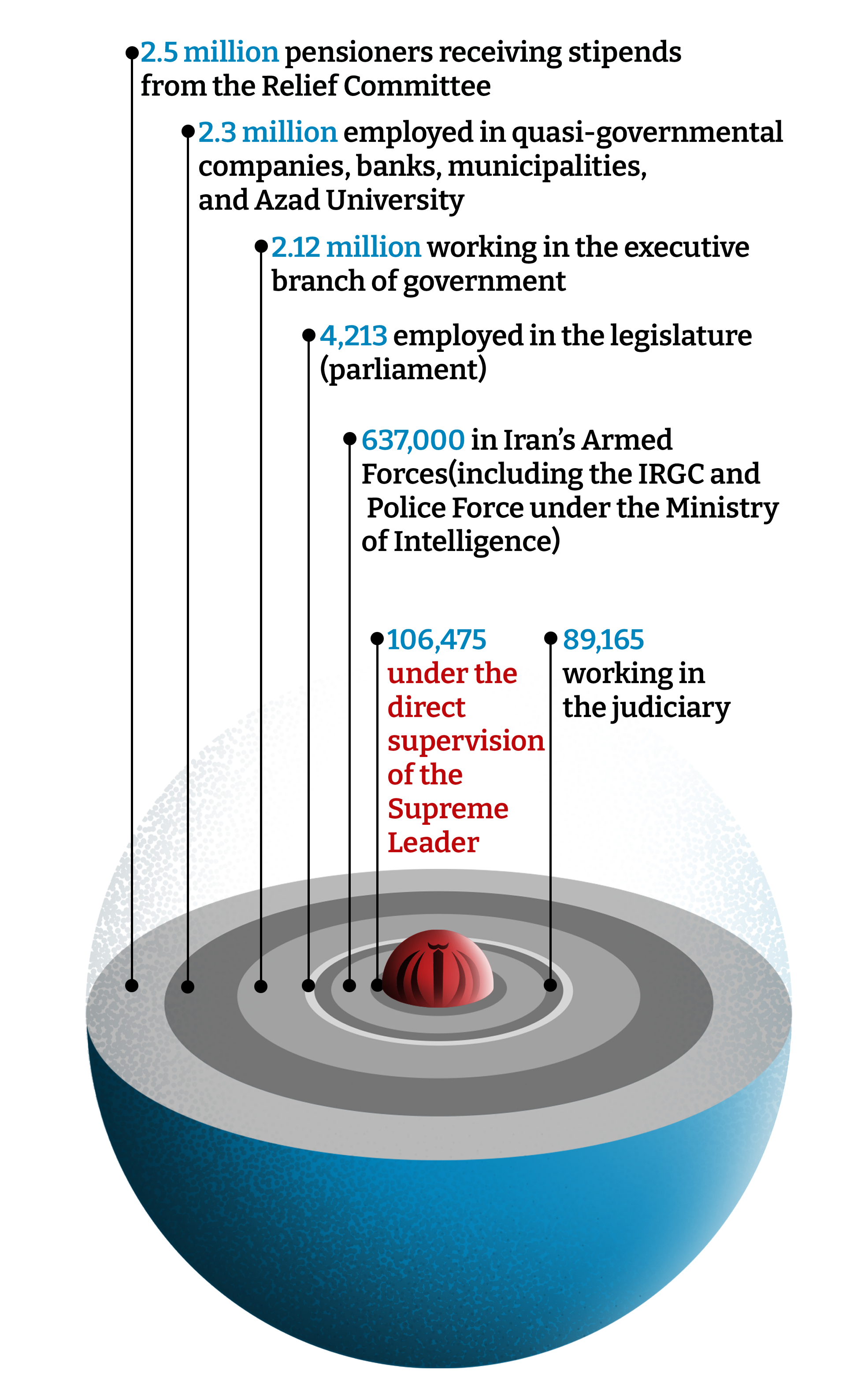
If one were to envision the Islamic Republic as a sphere, findings from show that it is surrounded by roughly 8 million people employed within its extensive state apparatus.
Among them, around 3 million are formally employed within the three branches of government, the armed forces, and various leadership organizations. An additional 2.3 million work in quasi-governmental companies, banks, municipalities, and Azad University. Meanwhile, 2.5 million are pensioners receiving stipends from the Relief Committee.
Iran International’s research further reveals:
In Iran, nearly one in ten citizens maintains a regular financial relationship with the Islamic Republic.
For every 140 ordinary citizens in Iran, there is at least one armed personnel member.
For every 2,800 citizens in the Islamic Republic, there is one security personnel member.
Compared to the 5 million employees in the Islamic Republic’s administrative body, there are approximately 380,000 senior, mid-level, junior, and operational managers and commanders.
Over 100,000 people are directly employed under the supervision of the state’s Supreme Leader, Ali Khamenei.
In anti-riot units, employment status is used as leverage to ensure obedience.
Under the Supreme Leader’s direct supervision
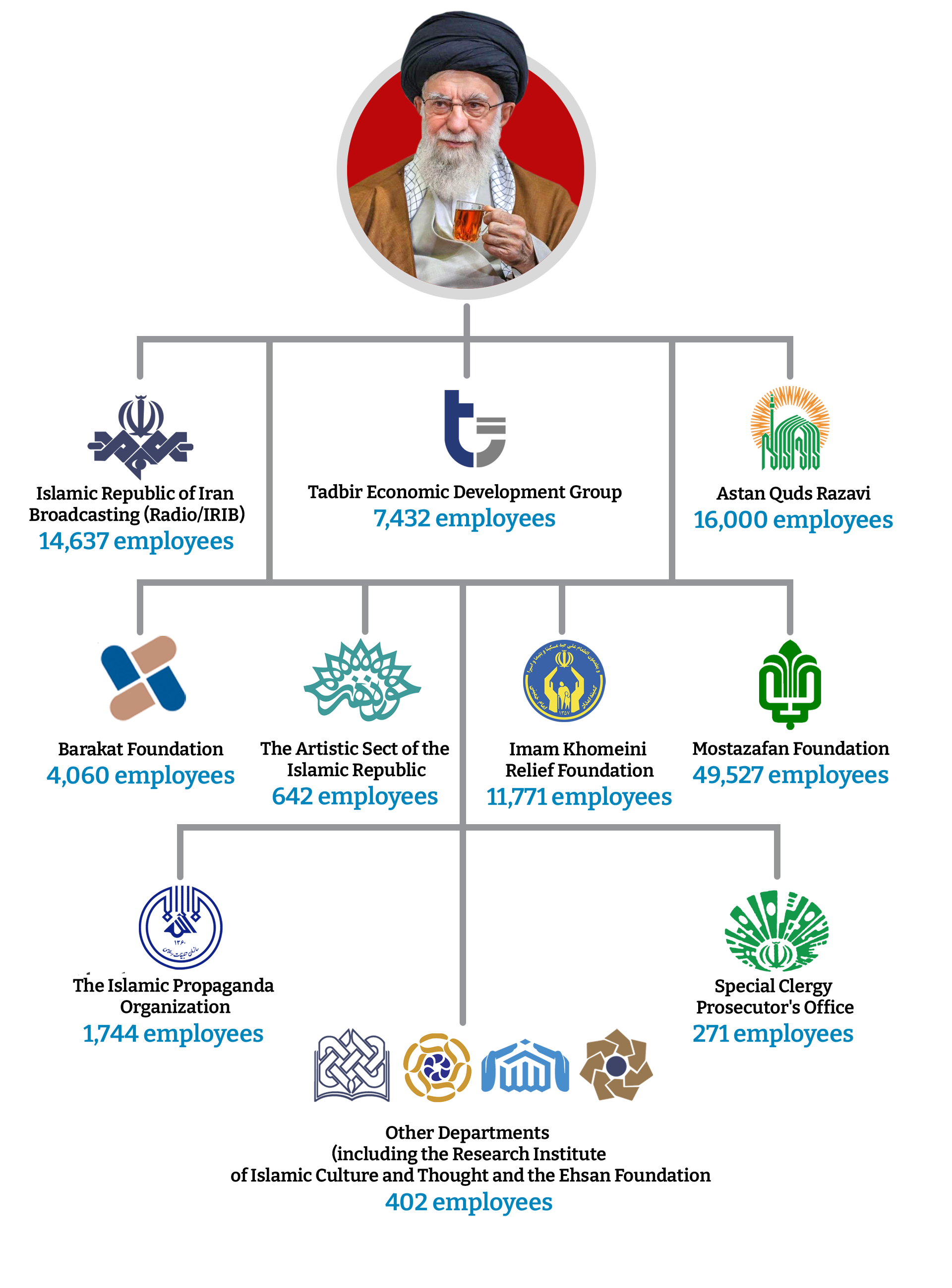
The Supreme Leader, as the ultimate authority and ruling power in Iran, directly oversees the employment of approximately 106,500 people. These individuals are spread across various sectors, including one judicial organization, three cultural institutions, one propaganda organization, and six economic entities. Nearly half of them— approximately 49,500 people—work in around 190 holdings, institutions, and companies affiliated with the Mostazafan Foundation, one of the largest and most powerful economic entities in Iran, established after the Islamic Revolution in 1979.
Employees under direct supervision of the Supreme Leader
Over 16,000 people are employed by Astan Quds Razavi, a powerful religious and economic institution in Iran that manages the Imam Reza Shrine in Mashhad. Its custodian is appointed by Khamenei. These employees work across 70 companies and institutions under the Razavi Economic Organization, including the 320-bed Razavi Hospital, Astan Quds Museums, Razavi Islamic Sciences University, the Razavi Cultural Foundation, and the Astan Quds Islamic Research Center.
Islamic Republic of Iran Broadcasting (IRIB), the state-run media, operates outside the formal government branches but is overseen by a head appointed by Khamenei. With around 14,600 employees, it is the third-largest organization under his control. IRIB has been sanctioned by the US and EU for its role in censorship, propaganda, and human rights abuses.
The Relief Committee, a charitable organization operating under Khamenei’s direct supervision, also serves as a political tool to bolster regime support. It is the fourth-largest organization under the Supreme Leader’s supervision, with 11,800 employees.
Information about the Execution of Imam Khomeini’s Order (EIKO) is limited. However, it is known that this entity controls significant amounts of land and property, with a dedicated office in each province to manage these assets. In recent years, some of EIKO’s activities have become more visible, possibly due to the need for collaboration with foreign partners. Generally, the entity’s economic activities are conducted through the companies of the Tadbir Economic Development Group, which employs around 7,400 people across its various subsidiaries.
The Barakat Pharmaceutical Group, a subsidiary of EIKO, was the exclusive importer of COVID-19 diagnostic kits and the producer of the COVIran Barekat vaccine during the pandemic. This group employs around 4,000 people.
The Islamic Propagation Organization is regarded as one of the primary propaganda arms of the Islamic Republic. It oversees subsidiaries such as Mehr News Agency, the English-language Tehran Times newspaper, and the Tebyan Institute. Its most notable role, however, is organizing state-backed rallies, such as those held on February 11th across the country. The organization employs 1,700 people.
Khamenei has referred to the Islamic Revolution Art Organization, commonly known as the Art Bureau, as the “Hope of the Art of the Revolution.” This organization is actively involved in investing in the production of cinema films and employs 642 people.
The Special Clerical Court, a parallel institution to the judiciary that operates under the Supreme Leader’s authority and deals exclusively with crimes committed by clerics, has 271 employees.
Military, security, and plainclothes personnel
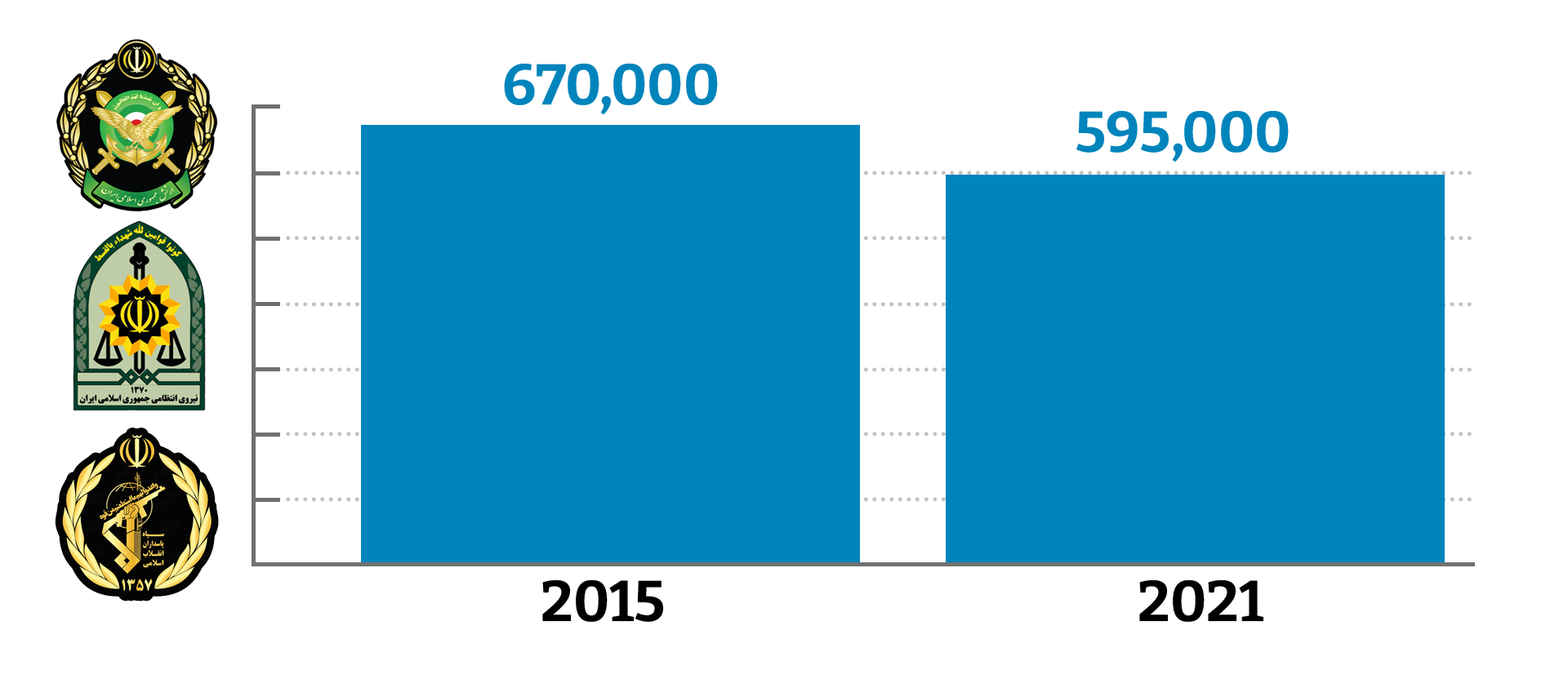
The country’s armed forces are also under Khamenei’s supervision. While their exact numbers are not disclosed, the Armed Forces Social Security Organization, which covers military personnel from the Army (“Artesh”), the IRGC (Islamic Revolutionary Guard Corps), and the Law Enforcement Forces (NAJA), includes 595,000 personnel. In 2015, the number of armed forces personnel registered with this organization was 670,000.
This indicates that from 2015 to 2021, the number of armed forces personnel in the Islamic Republic decreased by more than 11%. It is estimated that in the Islamic Republic, there is at least one armed personnel member for every 140 ordinary citizens.
Personnel in the Islamic Republic’s Army, IRGC, and Law Enforcement Force
The employees under the powerful Ministry of Intelligence
From an employment classification perspective, the employees of the Ministry of Intelligence are considered part of the government. However, the Minister of Intelligence is directly approved by Khamenei, and this ministry is distinct from the government due to the nature of its mission.
In 2019, the Defense Intelligence Agency (DIA), a key component of the US Department of Defense, estimated that the Ministry of Intelligence of the Islamic Republic had around 30,000 employees. Many Ministry of Intelligence personnel work as security officers (“Herasat”) in various government departments.
In the second part of Clause ‘T’ of the Ministry of Intelligence Employment Law, ratified in 1995, specific provisions are outlined regarding the employment policies and practices for employees of the Ministry.
“… (The mission is defined as) temporarily sending an employee to other ministries, institutions, governmental and non-governmental companies, military and law enforcement forces, revolutionary organizations, municipalities, and companies where the applicability of the law requires mention by name or has a specific law.”
In February 2023, Seyed Hossein Hojjati, the Deputy Minister of Intelligence and Head of the National Security Organization, announced at a conference that 30,000 security officers were deployed on the streets to suppress protests.
These factors strongly suggest that, although there is no precise and transparent data on the number of personnel in the Ministry of Intelligence, the estimate of 30,000 intelligence officers is a credible one. This implies a substantial security presence, with approximately one officer for every 2,800 citizens in the Islamic Republic.
Active Basij members and their key role in propping up state authority
In addition to military and security forces, there are also 12,700 active Basij members – a key paramilitary organization. These members support the state by promoting Islamic values, enforcing state policies, and maintaining public order. They notably mobilize to suppress dissent, reinforcing the regime’s authority and objectives.
While the total number of Basij members may be greater, the above figure represents the professional Basij forces who are officially insured. Among them, 6,200 reside in Tehran, followed by Isfahan with 1,300 active members, and Khorasan Razavi with 704 active Basij members.
Workforce of Iran’s judiciary system
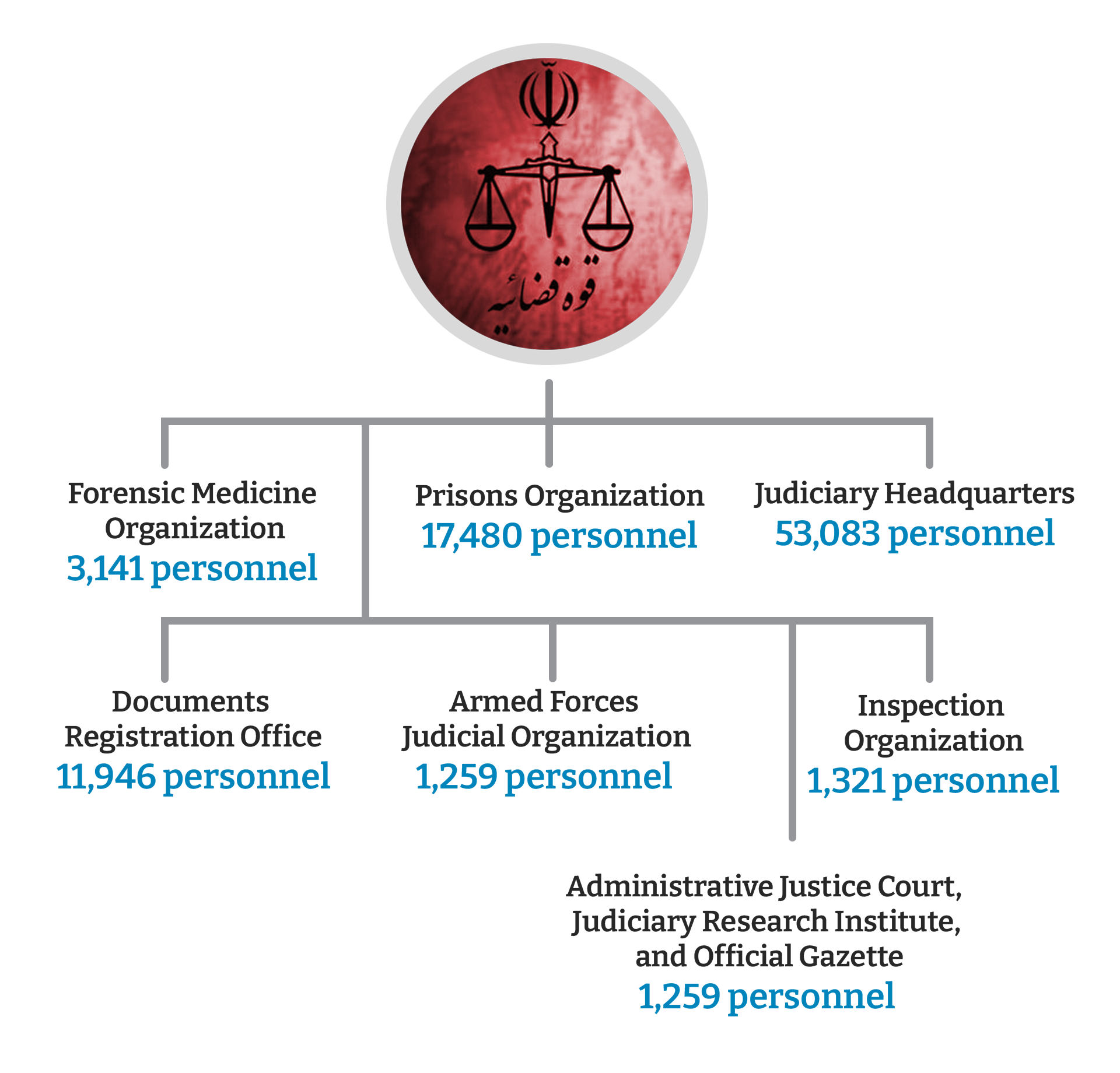
More than 89,000 people are employed in the state’s Judiciary. The central administration of the Judiciary employs approximately 53,000 individuals, including 39,700 men and 13,400 women. Among the staff, 1,300 hold less than a high school diploma, while 5,200 have either a high school diploma or an associate degree. Of the 53,000 employees in the central administration, only 689 possess a doctoral degree.
The Prisons Organization is the second-largest division within the Judiciary, employing 17,500 staff members, including approximately 2,000 women and 15,500 men. The Deeds and Properties Registration Organization follows as the third-largest section, with around 12,000 employees.
Number of legislative employees
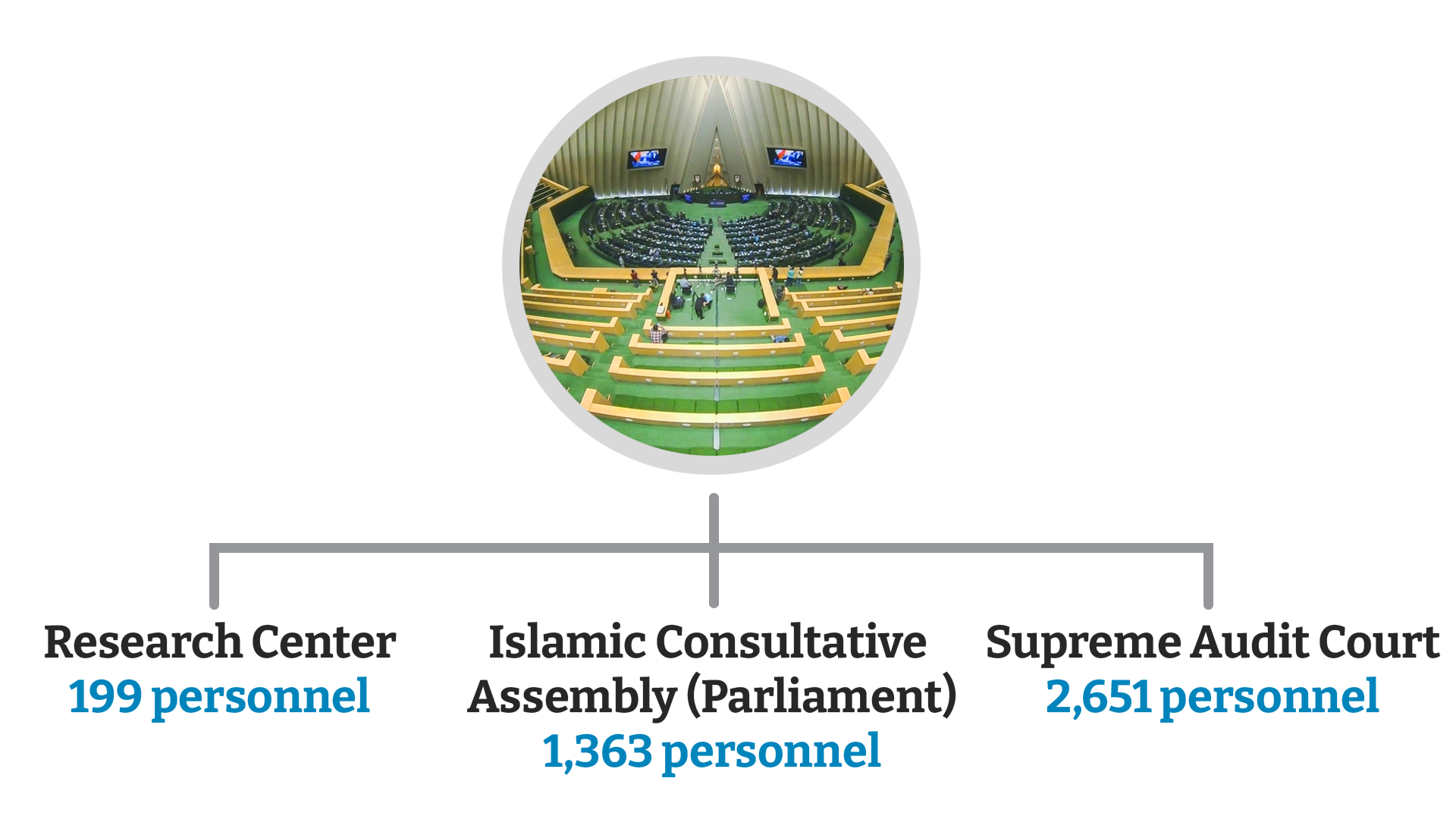
The smallest branch among the three branches of the Islamic Republic is the Legislature, which has a total of 4,200 employees across its three subdivisions. Of these, 1,400 work in the Islamic Consultative Assembly (Parliament), 2,600 are employed by the Supreme Audit Court, responsible for preparing the budget audit report, and approximately 200 work at the Parliament’s Research Center.
Employment dynamics in government sectors
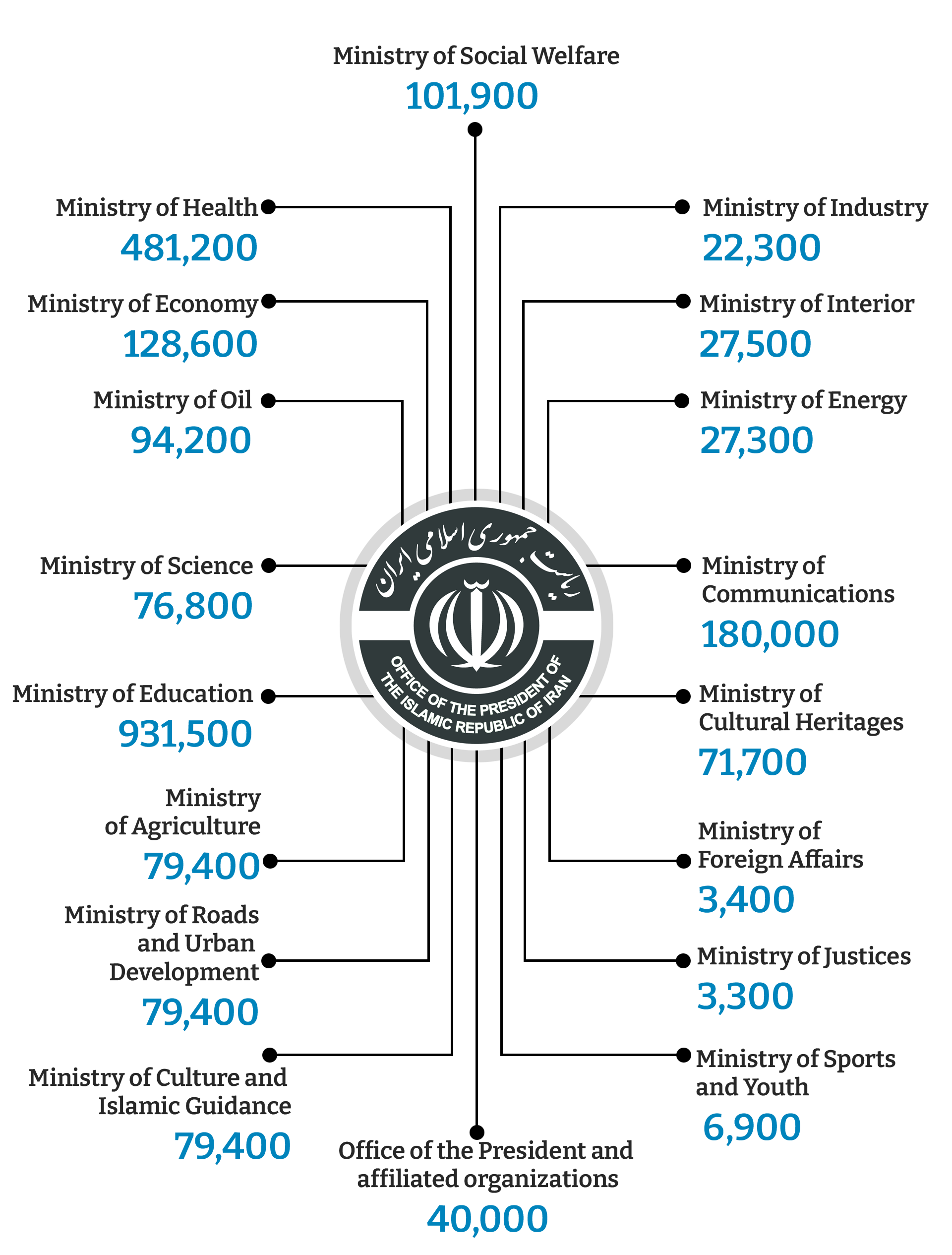
Seventeen ministries (excluding the Ministry of Intelligence and the Ministry of Defense), along with 42 organizations, foundations, institutions, and offices under the presidency, employ a total of 2,123,637 people. Of these, 1,447,000 are formally employed, while 676,700 are employed informally.
Office of the President and affiliated organizations
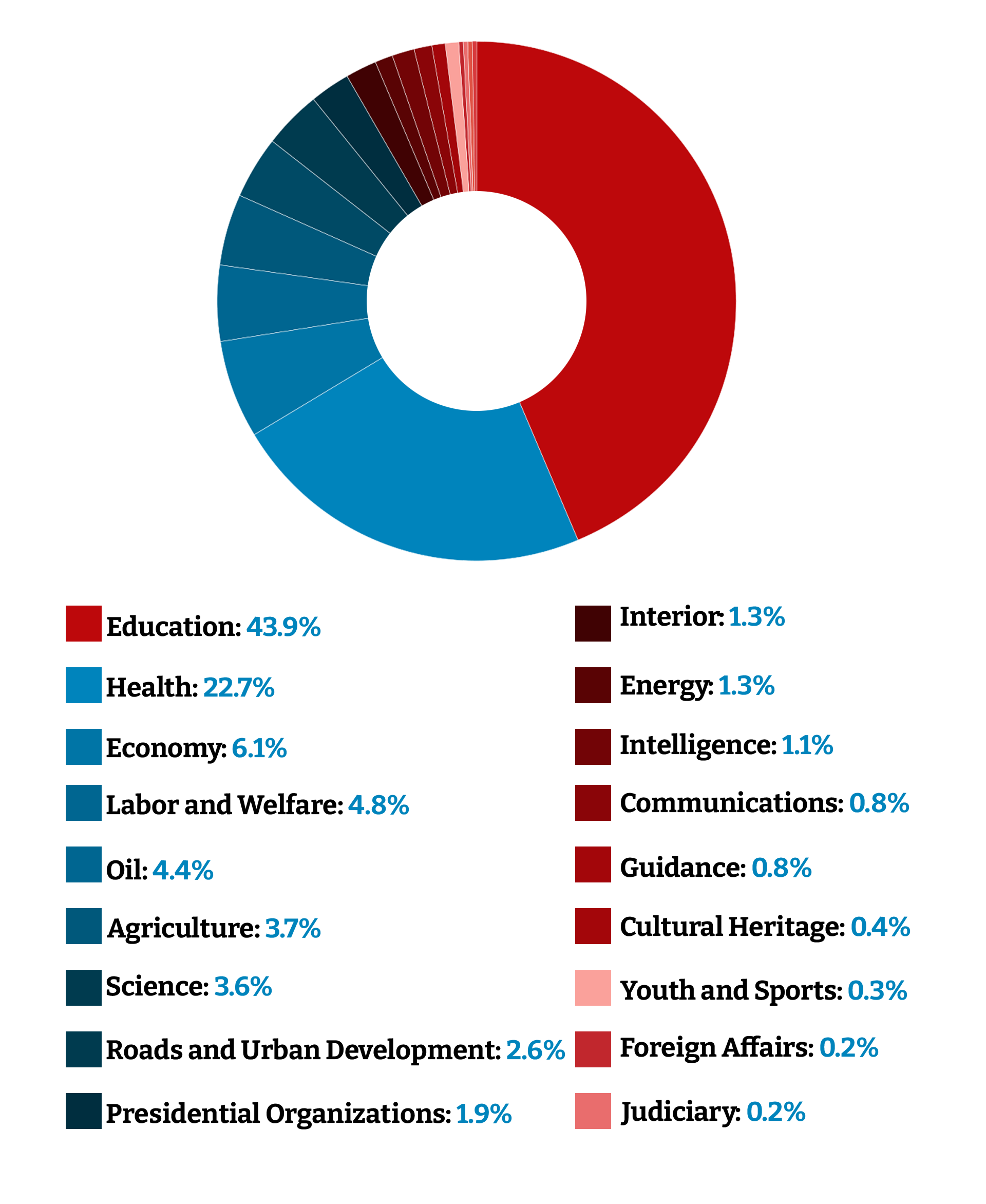
Two ministries—Education, with 931,500 employees, and Health, with 481,200 employees—together account for 67% of all government employees
Distribution of government employees in ministries and subordinate agencies to the president
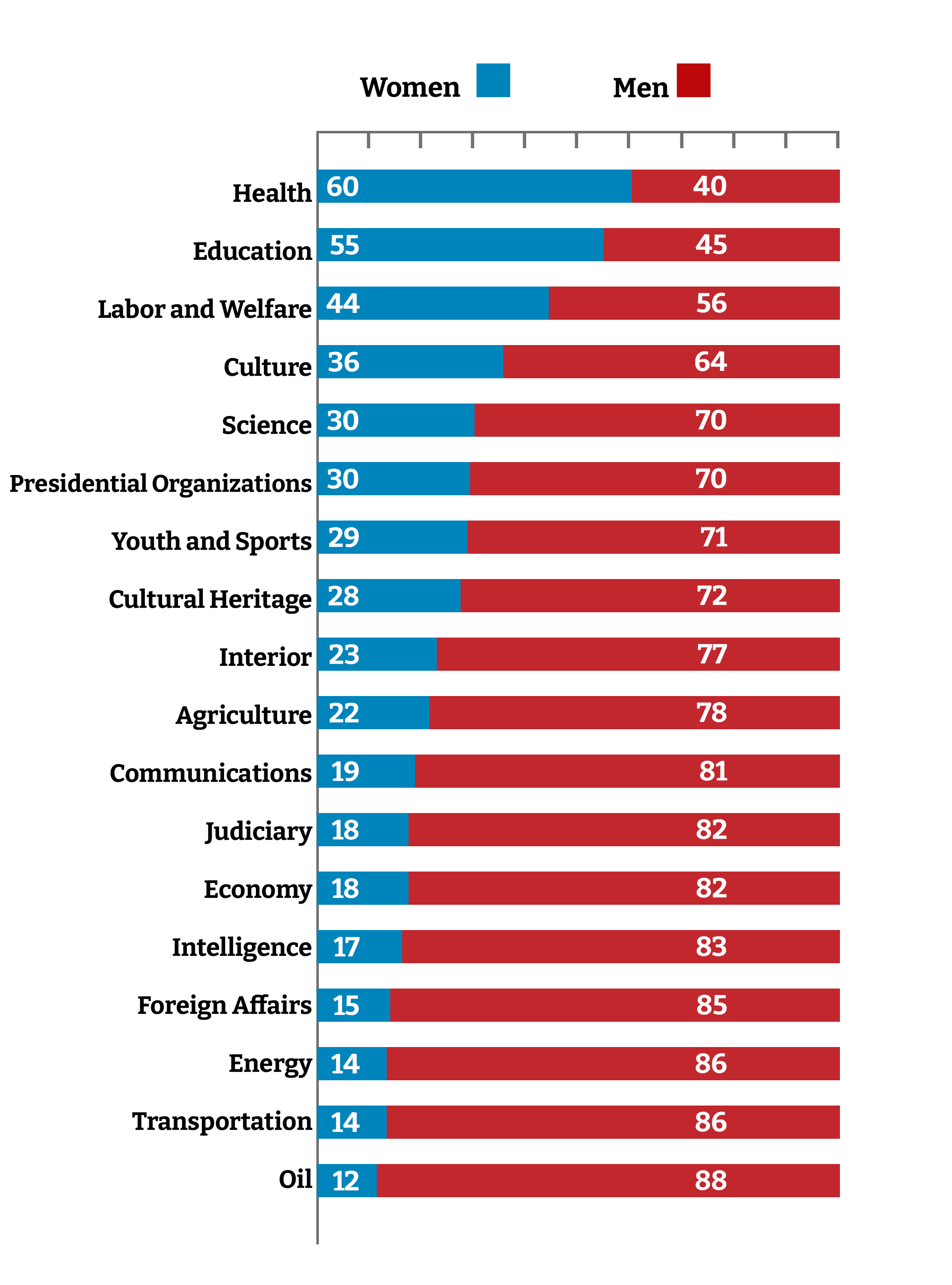
These two ministries are unique in that the number of female employees exceeds that of male employees. Women make up 60% of the workforce in the Ministry of Health and 55% in the Ministry of Education. In contrast, the average representation of women among all government employees is only 27%.
Gender composition of government employees in ministries
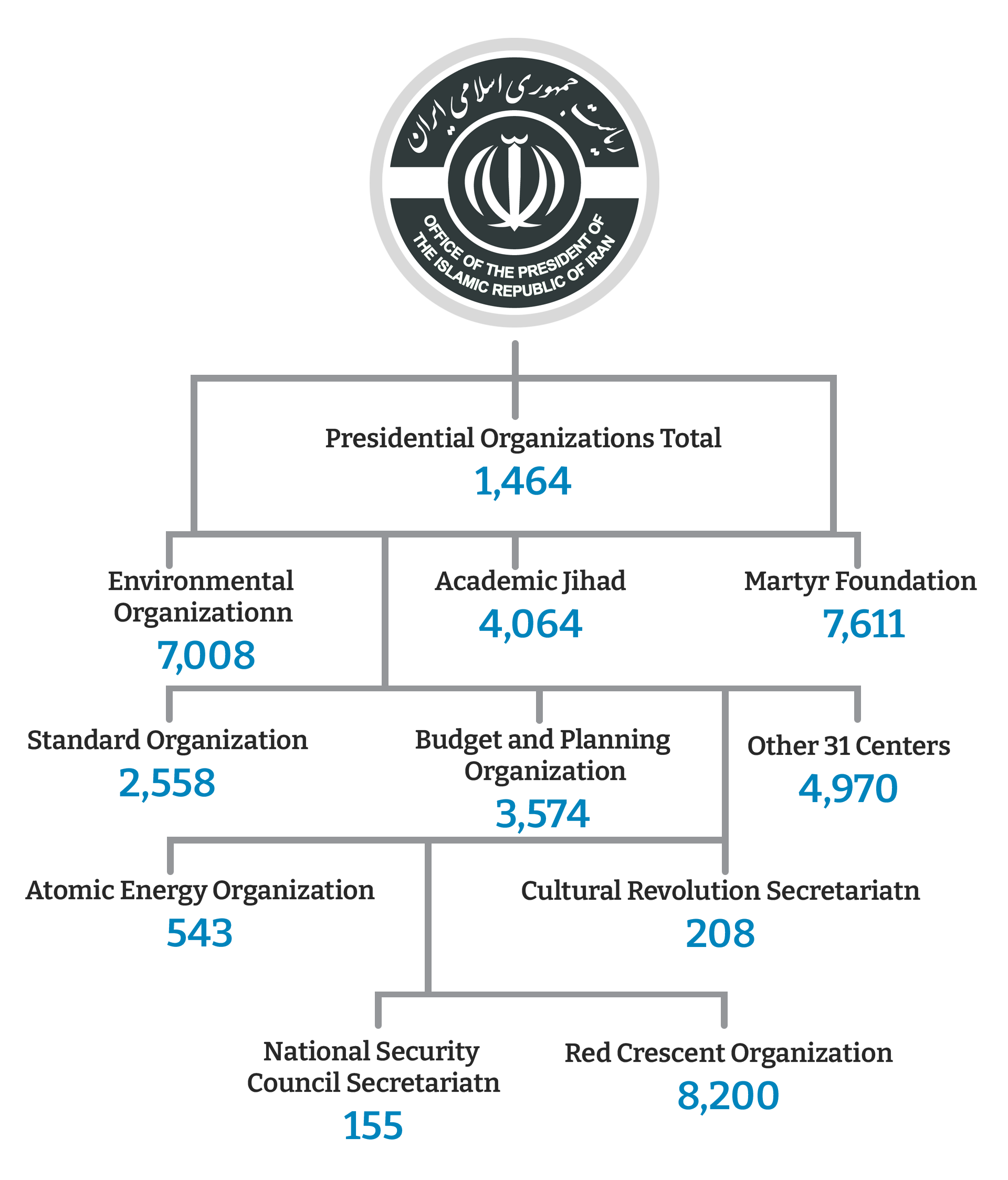
Forty-one organizations, institutions, and foundations operate under the presidency, collectively employing around 40,000 people. Although the Red Crescent Society is classified as a supranational organization within the administrative employment system, it effectively operates under the presidency and employs about 8,200 individuals. The Foundation of Martyrs, with 7,600 employees, is the second-largest organization under the presidency. Following it are the Environmental Protection Organization, Jihad University, and the Planning and Budget Organization. The Presidential Institution itself employs approximately 1,500 people.
Number of employees in the presidential organizations
Dissatisfaction in the armed forces
In an interview with Iran International, a former armed forces member highlighted significant dissatisfaction in Iran’s military, particularly within the Army. He noted that the highest discontent is in the Air Force and Air Defense, with personnel in Air Defense increasingly unhappy since its separation from the Air Force.
According to this anonymous source, dissatisfaction is also significant among the Ground Forces of the Army. The restructuring of divisions into headquarters and brigades has contributed to growing discontent among personnel. He observed that many soldiers, particularly in larger cities, are compelled to take on second and even third jobs to supplement their income.
He also highlighted the deteriorating state of military housing, noting that a lack of maintenance has led to increasingly poor conditions year after year, forcing residents to endure such dilapidated living situations out of necessity. In his assessment, Navy personnel experience the least dissatisfaction within the Army.
Regarding the Law Enforcement Forces (NAJA), he indicated that they rank next in dissatisfaction. He pointed out the widespread issue of bribery within the organization and remarked, “In your opinion, how far from Valanjak police station in Tehran can a sergeant afford to rent a small house with their salary? Most of the personnel in Tehran, especially newcomers, live in suburbs around Tehran.”
The state’s use of employment status as a tool for repression
The former armed forces member also spoke to Iran International about the state’s usage of employment status as a lever to coerce personnel into suppressing protests.
He explained that “contracted sergeants are the main pillar of the suppression forces in the Law Enforcement Forces.”
Their fear of not becoming permanent employees serves as a significant pressure point, he said, noting that the recruitment committee quietly prioritizes candidates who are financially vulnerable, stating, “preference is given to the one with more financial problems, such as being the head of a family or having lost a father.”
In other words, the state intentionally hires individuals who are financially vulnerable, knowing that their need for job security will make them more compliant in carrying out repressive actions against protests and dissent
Salaries in the army, IRGC, and law enforcement
while base salaries for personnel in all branches of the armed forces are uniform, significant disparities exist in benefits, particularly regarding financial support.
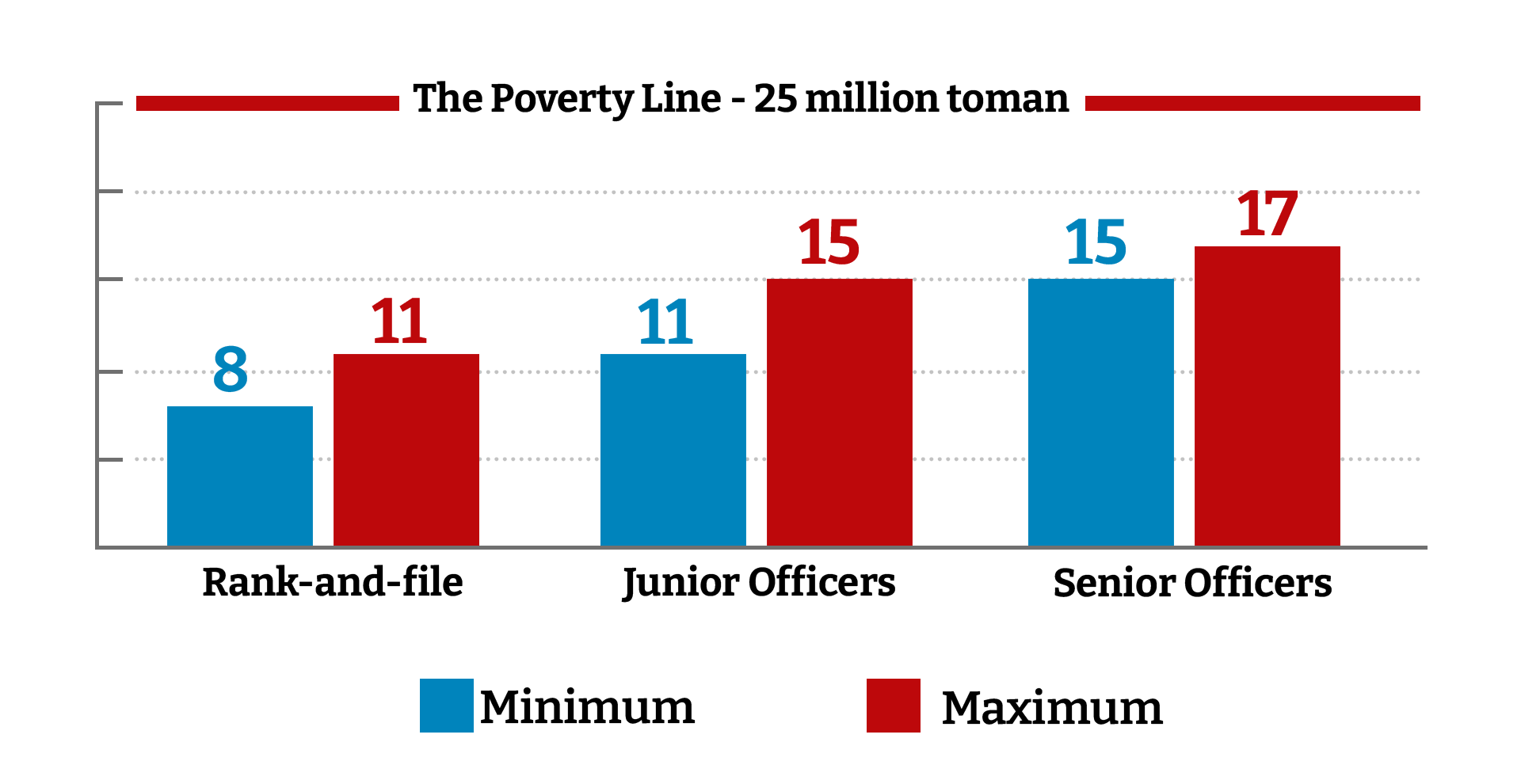
Average monthly salary of armed forces personnel
He pointed out the disparity, stating that, “For example, obtaining a housing purchase loan under code 62 in the Army and NAJA is difficult. However, in the IRGC, loans several times the amount in the Army and NAJA are granted to personnel at low interest rates as quickly as possible.”
Regarding the monthly salaries of the armed forces personnel, he explained that salaries for armed forces personnel differ by rank, with non-commissioned officers earning 8 to 11 million tomans, junior officers earning 11 to 15 million tomans, and senior officers earning 15 to 17 million tomans. He added that factors like years of service and unit assignment impact these amounts.
This level of income for armed forces personnel is concerning, especially considering that, according to Hamidreza Emam-Gholi Tabar, Inspector of the Supreme Assembly of Workers’ Representatives, the poverty line for a family of four was 25 million tomans in March 2024.
The quasi-governmental and private sector workforce
A significant portion of Iranian society maintains financial ties to the Islamic Republic through a network of quasi-governmental and private entities, despite not being formally part of the state’s administrative system. This sector, which includes banks, universities, and various companies, employs a substantial number of people across the country.
Although precise figures for the number of employees in these “quasi-state” companies are rarely disclosed, Iran International’s research offers insight into the employment landscape within this sector. For instance, the Social Security Investment Company (Shasta), with its 180 subsidiaries, employs around 50,000 people. Similarly, the Ghadir Investment Company, acting as the economic arm of the Armed Forces Pension Fund, employs 22,600 individuals across approximately 100 subsidiaries.
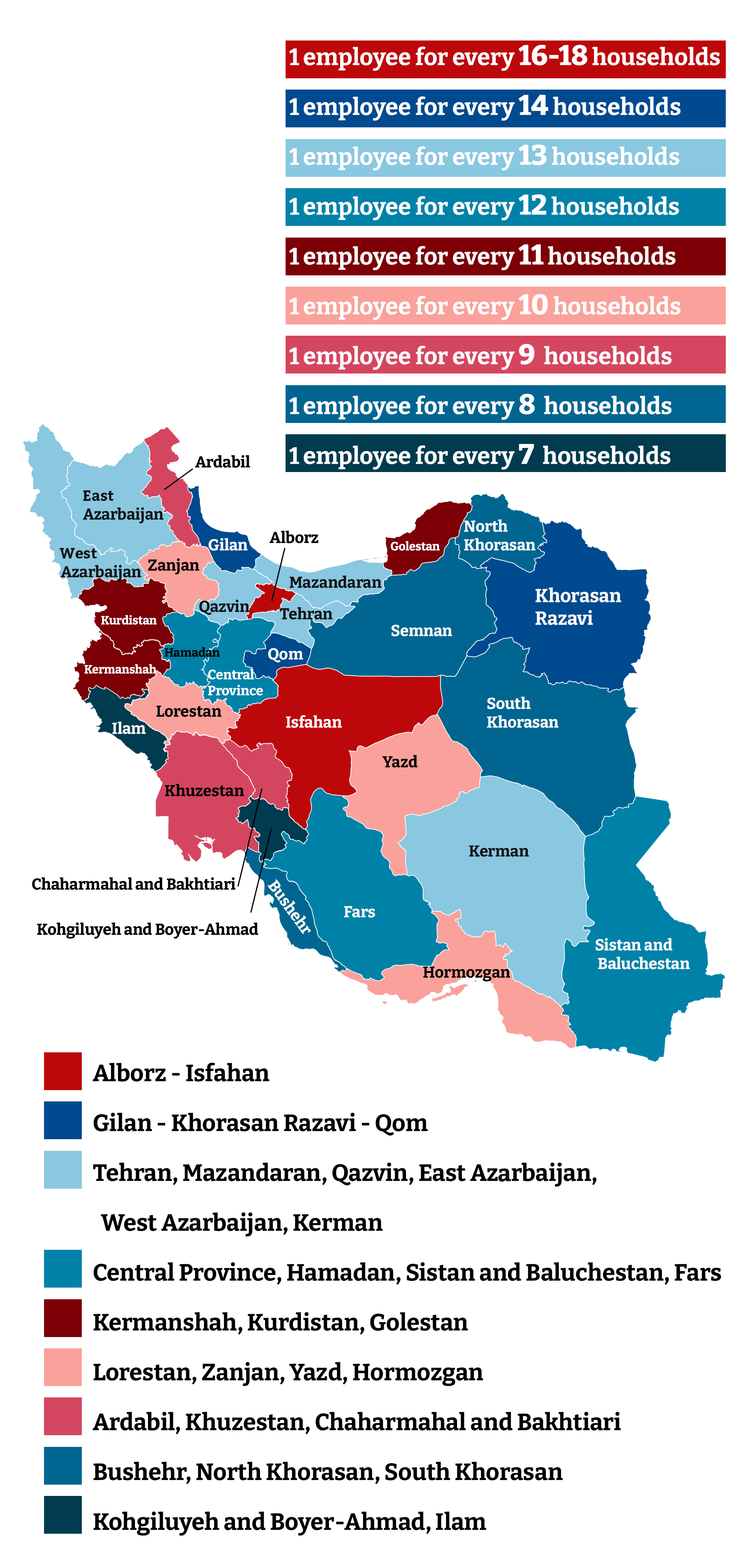
Ratio of government employees to households by province
In the industrial sector, Mobarakeh Steel Company, alongside its 110 subsidiaries in Isfahan, provides jobs for 38,700 people. The Golgohar Mining and Industrial Company, with 25 subsidiaries, employs 21,400, while the National Iranian Copper Industries Company employs 11,500 across its 17 subsidiaries. Chadormalu Mining and Industrial Company, with its 13 subsidiaries, accounts for 9,200 jobs, and the Khuzestan Steel Company, affiliated with the IRGC’s Payandan Economic Development Group, employs 14,200 individuals.
The automotive industry is also a major employer. Iran Khodro Company, together with its 90 subsidiaries, including Iran Khodro Diesel, employs 67,000 people. Saipa Company, with a similar subsidiary structure, provides jobs for 46,800 individuals. Together, these two automakers and their 180 subsidiaries employ a combined total of 113,900 people.
In the energy sector, Mapna Group, which oversees power plant projects across Iran, employs 28,300 people through its 80 subsidiaries. The Thermal Power Generation Holding Company, which manages 20 power generation units and 20 maintenance units, employs 11,400 people, while Iran Transfo, specializing in power transmission equipment, has a workforce of 3,800 spread across its main company and 18 subsidiaries.
Finally, the Iran Telecommunication Company, once one of the largest state-owned enterprises, now operates with a reduced but significant workforce of 49,000 people across its 20 subsidiaries, including Mobile Communications of Iran.
To date, no specific statistics or estimates have been provided regarding the total number of employees in Iran’s quasi-governmental companies. However, in January 2024, Alaeddin Azoudji, Director General of Performance Evaluation and Quality Control at the Supreme Audit Court, revealed that the actual number of quasi-governmental companies is around 2,000. He further indicated that if companies affiliated with non-governmental public institutions are included, this number could rise to approximately 3,000 companies.
In this report, the employment figures within these holding companies across various sectors were analyzed. On average, each subsidiary of these holdings employs about 600 people. Applying this average to the 3,000 companies mentioned by Azoudji suggests that approximately 1.8 million people are employed within the quasi-governmental sector of the Islamic Republic.
The state’s workforce behind its controversial banking sector
Apart from banks like Sepah, Melli, and others, where employees are considered part of the country’s administrative system, and Sina Bank, whose employees fall under the Mostazafan Foundation, there are 19 banks and institutions that are not legally part of the government but are affiliated with other sections of the Islamic Republic. These banks, and many of their subsidiaries, are not classified as quasi-governmental entities but are officially considered private sector institutions. However, due to the strategic importance of the banking sector, the Islamic Republic maintains strict oversight over them, similar to how it controls public or quasi-governmental organizations.
Many of these banks have been involved in controversial activities, including facilitating financial transactions for sanctioned entities, money laundering, and financing Iran’s military and paramilitary operations. Consequently, several of these banks have been sanctioned by international bodies, particularly by the United States and the European Union, for their roles in supporting the regime’s activities, including those linked to human rights abuses and terrorism.
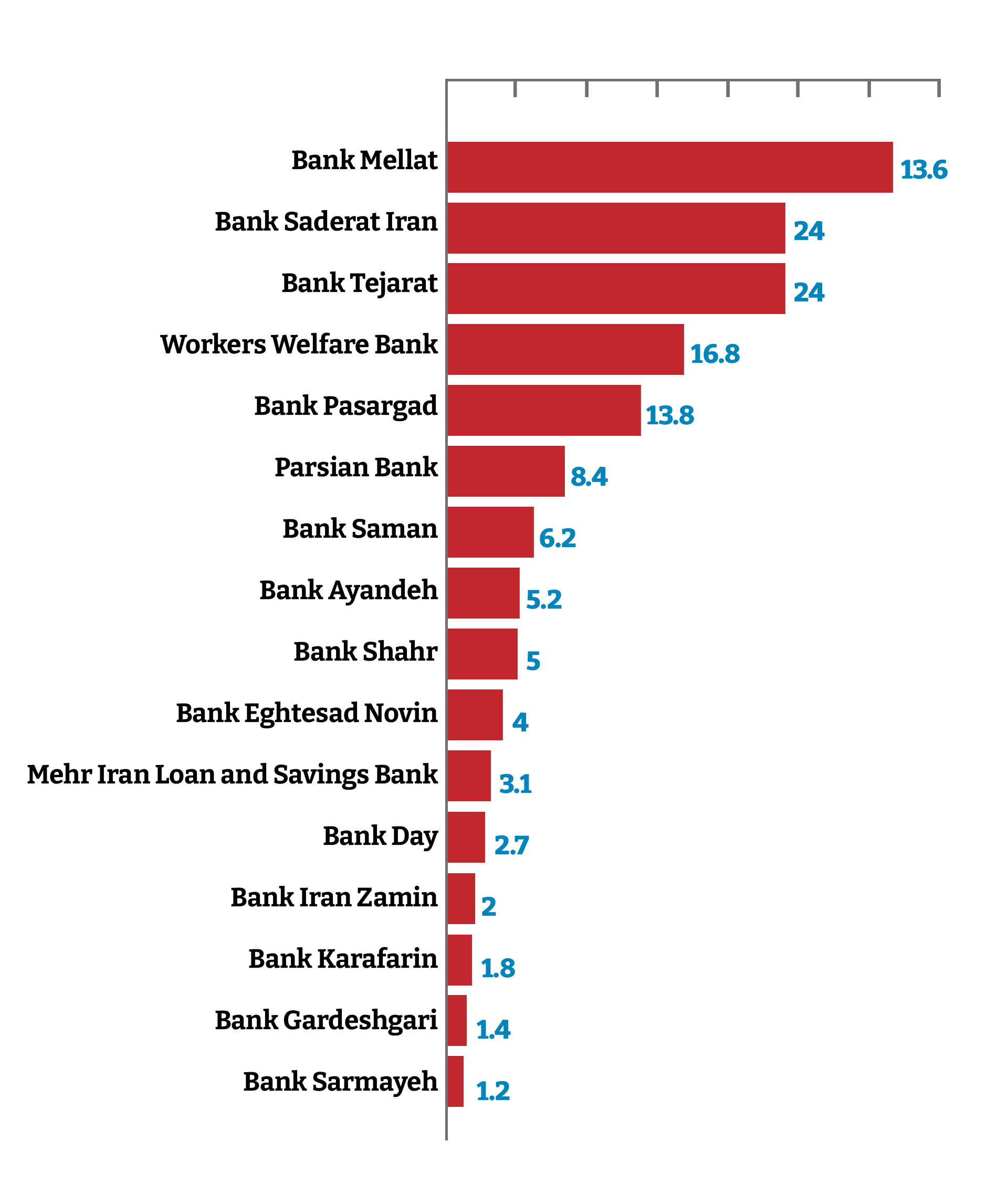
Number of Banking Network Employees (thousands)
Nonetheless, these banks continue to employ a significant workforce. In total, 153,300 people are employed by these institutions, including those working in the subsidiaries of the larger banks.
Iran’s educational and municipal employment landscape
Some major institutions operate outside the formal branches of government, such as the Islamic Azad University, which employs 26,800 administrative staff and 20,600 faculty members. The university is one of the largest private universities in the world, with campuses across Iran and significant influence in both educational and political spheres. While it is nominally independent, it has close ties to the state, particularly to the Supreme Leader, who appoints its board of trustees. The university has become known for its role in promoting the regime’s ideology and for being a tool of political patronage.
Additionally, the number of municipal employees nationwide was last reported in 2017 by the Director General of the Renovation and Administrative Transformation Office of the Municipalities and Village Councils Organization. At that time, there were 300,000 municipal employees across the country, with 70,000 employed by the Tehran Municipality alone. Municipalities, especially in major cities like Tehran, are not just administrative bodies but also significant political entities, often involved in implementing state policies at the local level. Tehran Municipality, in particular, has been a focal point of political power struggles and has faced allegations of corruption and mismanagement.
The 4.8 million tied to the state through financial dependence
According to research by Iran International, approximately 4.8 million people in Iran maintain financial ties to the Islamic Republic through various channels, including the quasi-governmental sector. This sector alone employs about 1.8 million individuals. When combined with 153,300 employees in the banking sector, 300,000 municipal workers, and 47,000 staff at Islamic Azad University, the total workforce connected to the regime reaches 2.3 million people.
Additionally, during the presidential election campaign, a video surfaced showing supporters of a candidate threatening to cut off stipends from the Relief Committee to secure votes. The committee provides ongoing support to 2.5 million families in need, including 2,272,000 receiving livelihood assistance and 198,000 receiving non-livelihood support. These households represent a population of 4.3 million people, and it’s estimated that around 2.5 million adults have a direct financial relationship with the Islamic Republic through the Relief Committee, despite not being employed in quasi-governmental or state-run sectors.
This data underscores the extensive financial dependencies that tie nearly 4.8 million people to the regime, revealing the breadth of its influence across society.
Ministry of Interior employees and discontent with the IRGC
In an interview with Iran International, an employee of the Ministry of Interior working in border areas discussed the growing discontent among the ministry’s personnel.
He revealed, “Even among the junior and operational managers, there is discontent, and the level of dissatisfaction in this ministry is high.” He further explained that economic struggles affect even the high-ranking employees within the Ministry of Interior.
The employee also highlighted the limited power of senior officials, particularly those with military backgrounds, in border areas. He stated, “In the Ministry of Interior, senior positions are given to those with military backgrounds. In border areas, even the managers of the Ministry of Interior have no significant power, and in these areas, although border control is the responsibility of the Ministry of Interior, in practice, the power is in the hands of the IRGC.”
The employee also expressed a deep-seated frustration among his colleagues, saying, “I believe that a large part of the Ministry of Interior employees have developed a kind of passive anger. Employees who have been suppressed in the administrative structure and do not even have the ability to protest or change the smallest administrative conditions gradually become more compliant but harbor an internal anger towards the system.”
The state’s 5 million administrative employees on edge
The Islamic Republic’s administrative workforce is a ticking time bomb, with nearly 5 million employees trapped in a system that underpays and overburdens them. These workers, spanning from typists in government offices to neighbourhood police officers, struggle to survive on salaries that often fall below the poverty line.
Many are forced to take on second and third jobs just to make ends meet. With economic pressures mounting, this vast body of disillusioned employees—who possess insider knowledge and access to sensitive information—could become a formidable force against the regime.
Like Majid Khoshmanzar, who sabotaged the regime’s surveillance efforts, any one of these 5 million could turn their frustrations into actions that destabilize the very system they serve.
Sources:
1. Foundation of the Oppressed. (2016). Explanatory Notes to Financial Statements. Financial year ending March 20, 2017, p. 13.
2. Razavi Oil and Gas Development. (2022). Explanatory Notes to Financial Statements. Financial year ending March 20, 2023, p. 7. Razavi Quality Institute. (2022). Explanatory Notes to Financial Statements. Financial year ending March 20, 2023, p. 6. Housing and Urban Development of Razavi Quds. (2022). Explanatory Notes to Financial Statements. Financial year ending March 20, 2023, p. 8. Razavi 320-Bed Hospital Institute. (2022). Explanatory Notes to Financial Statements. Financial year ending March 20, 2023, p. 7. Razavi Animal Husbandry and Dairy Industries. (2022). Explanatory Notes to Financial Statements. Financial year ending March 20, 2023, p. 6. Razavi Light Construction. (2022). Explanatory Notes to Financial Statements. Financial year ending March 20, 2023, p. 8. Razavi Islamic Sciences University Institute. (2022). Explanatory Notes to Financial Statements. Financial year ending March 20, 2023, p. 6. Pioneers of Sirir Investment. (2022). Explanatory Notes to Financial Statements. Financial year ending September 22, 2022, p. 6. Razavi Cultural Foundation. (2022). Explanatory Notes to Financial Statements. Financial year ending June 21, 2022, p. 7. Razavi Seed and Seedling Institute. (2022). Explanatory Notes to Financial Statements. Financial year ending December 21, 2022, p. 7. Explanatory Notes to Financial Statements of Razavi Advanced Industries. (2022). Explanatory Notes to Financial Statements. Financial year ending March 20, 2023, p. 10. Razavi Pharmaceutical Services. (2022). Explanatory Notes to Financial Statements. Financial year ending March 20, 2023, p. 6. Razavi Supply Chain Management. (2022). Explanatory Notes to Financial Statements. Financial year ending March 20, 2023, p. 6. Razavi Agriculture. (2022). Explanatory Notes to Financial Statements. Financial year ending December 21, 2022, p. 8. Razavi Information and Communications Technology. (2022). Explanatory Notes to Financial Statements. Financial year ending March 20, 2023, p. 7. Razavi Business. (2022). Explanatory Notes to Financial Statements. Financial year ending March 20, 2023, p. 7. Razavi Securities Brokerage. (2023). Explanatory Notes to Financial Statements. Interim period ending September 22, 2023, p. 6. Mahab Quds Engineering and Consulting. (2021). Explanatory Notes to Financial Statements. Financial year ending March 20, 2022, p. 12. Foundation for Islamic Research of Astan Quds. (2021). Explanatory Notes to Financial Statements. Financial year ending March 20, 2022, p. 6. Razavi Yeast. (2023). Explanatory Notes to Financial Statements. Financial year ending September 22, 2023, p. 7. Razavi Market Organization. (2022). Explanatory Notes to Financial Statements. Financial year ending March 20, 2023, p. 8. Razavi Mines. (2021). Explanatory Notes to Financial Statements. Financial year ending March 20, 2022, p. 6. Razavi Flour. (2021). Explanatory Notes to Financial Statements. Financial year ending March 20, 2022, p. 6. Library, Museum, and Document Center of Astan Quds Razavi Institute. (2022). Explanatory Notes to Financial Statements. Financial year ending March 20, 2023, p. 7. Consulting Engineers of Astan Quds Razavi. (2021). Explanatory Notes to Financial Statements. Financial year ending March 20, 2022, p. 6. Astan Quds Razavi Carpet Production. (2021). Explanatory Notes to Financial Statements. Financial year ending March 20, 2022, p. 6.
3. Data Governance Development Office. (September 2023). National Administrative System in 2022. Electronic Governance and Administrative Smartening Department, pp. 276 and 278.
4. Explanatory Notes to Financial Statements of Tadbir Economic Development Group. (2021). Explanatory Notes to Financial Statements. Financial year ending March 20, 2022, p. 11.
5. Barakat Pharmaceutical Group. (2023). Explanatory Notes to Financial Statements. Interim period ending September 22, 2023, p. 11.
6. Data Governance Development Office, September 2023, National Administrative System in 2022, Electronic Governance and Administrative Smartening Department, pp. 274 to 277.
7. Maleki, M., Forouzanfir, M., & Hosseinali Zadeh, R. (November 2023). Instability of Pension Funds (2). Research Center of the Islamic Consultative Assembly, p. 19.
8. Adabi Firouzjaei, B. (Winter 2017). Case Study of the Armed Forces Pension Fund. Defense Economy Quarterly, p. 22.
9. Statistics, Information, and Computation Management. (July 2022). Statistical Yearbook of the Social Security Organization for 2021. Social Security Organization, p. 34.
10. Data Governance Development Office. (September 2023). National Administrative System in 2022. Electronic Governance and Administrative Smartening Department, pp. 101 to 280.
11. Social Security Investment. (2023). Financial Statements. Period ending December 21, 2023, pp. 64 to 72 and p. 13.
12. Ghadir Investment. (2023). Financial Statements. Period ending December 21, 2023, pp. 54 to 56 and p. 13.
13. Isfahan Mobarakeh Steel. (2023). Financial Statements. Period ending September 22, 2023, pp. 50 to 52 and p. 14.
14. Gol Gohar Mining and Industrial. (2023). Financial Statements. Period ending March 20, 2024, pp. 43 and 44 and p. 12.
15. National Iranian Copper Industries. (2023). Financial Statements. Period ending September 22, 2023, pp. 13 and 45.
16. Chador Malu. (2023). Financial Statements. Period ending March 20, 2024, pp. 11, 45 and 46.
17. Khouzestan Steel. (2023). Financial Statements. Period ending September 22, 2023, p. 12.
18. Iran Khodro. (2023). Financial Statements. Period ending September 22, 2023, pp. 14, 56, 57 and 58.
19. Saipa. (2023). Financial Statements. Period ending September 22, 2023, pp. 12, 54, 55 and 56.
20. Mapna. (2023). Financial Statements. Period ending October 22, 2023, pp. 39, 40 and 12.
21. Thermal Power Generation Specialized Mother Company. (2022). Financial Statements. Period ending March 20, 2023, pp. 39 and 14.
22. Iran Transfo. (2023). Financial Statements. Period ending September 22, 2023, pp. 15 and 49.
23. Iran Telecommunications. (2023). Explanatory Notes to Financial Statements. Financial year ending September 22, 2023, pp. 50, 51 and 16.
24. Bank Mellat. (2023). Explanatory Notes to Financial Statements. Period ending March 20, 2024, p. 14. Bank Saderat Iran. (2023). Explanatory Notes to Financial Statements. Period ending September 22, 2023, p. 14. Bank Tejarat. (2023). Explanatory Notes to Financial Statements. Period ending September 22, 2023, p. 15. Bank Refah. (2023). Explanatory Notes to Financial Statements. Period ending September 22, 2023, p. 12. Bank Pasargad. (2023). Explanatory Notes to Financial Statements. Period ending September 22, 2023, p. 14. Bank Parsian. (2023). Explanatory Notes to Financial Statements. Period ending September 22, 2023, p. 13. Bank Samaneh. (2023). Explanatory Notes to Financial Statements. Period ending September 22, 2023, p. 12. Bank Ayandeh. (2020). Explanatory Notes to Financial Statements. Period ending March 20, 2020, p. 12. Bank Shahr. (2023). Explanatory Notes to Financial Statements. Period ending September 22, 2023, p. 32. Bank Eqtesad Novin. (2022). Explanatory Notes to Financial Statements. Period ending March 20, 2023, p. 15. Bank Qarz al-Hassaneh Mehr Iranians. (2023). Explanatory Notes to Financial Statements. Period ending September 22, 2023, p. 7. Bank Dey. (2022). Explanatory Notes to Financial Statements. Period ending March 20, 2023, p. 15. Bank Iran Zamin. (2019). Explanatory Notes to Financial Statements. Period ending March 20, 2020, p. 13. Bank Karafarin. (2023). Explanatory Notes to Financial Statements. Period ending September 22, 2023, p. 12. Bank Gardeshgari. (2023). Explanatory Notes to Financial Statements. Period ending September 22, 2023, p. 13. Bank Sarmayeh. (2022). Explanatory Notes to Financial Statements. Period ending March 20, 2023, p. 12. Bank Resalat. (2023). Explanatory Notes to Financial Statements. Period ending September 22, 2023, p. 7. Bank Khavarmianeh. (2023). Explanatory Notes to Financial Statements. Period ending March 20, 2024, p. 15. Iran-Venezuela Joint Bank. (2022). Explanatory Notes to Financial Statements. Period ending March 20, 2023, p. 14.
25. Farhikhtagan. (2023). “40,000 People are Both Government Employees and Private Sector Activists.” Farhikhtagan Newspaper, No. 4085, p. 16.